The Christmas card debacle was devastating and tested the bonds of my marriage. For a more detailed account see the post How Ai Ruined My Christmas And Almost My Marriage
AI turned my Arsenal jersey into a Real Madrid kit.
It was technically impressive. The cartoon looked great. But the result was wrong in a way that mattered.
The model optimized for what was statistically common. Real Madrid appears far more often in global football imagery than Arsenal’s black third kit. So the system quietly replaced a specific truth with a global average.
That small moment revealed a larger issue.
Modern AI systems are incredibly capable, but they lack a center.
They generate answers based on patterns learned from the internet, not on the identity of the person or organization using them.
For casual tasks that works fine.
But for real decisions it quickly breaks down.
The Gap Between AI and Real Work
Most AI systems today follow a simple pattern.
- A user asks a question.
- The model generates a response.
- The response is returned.
This design works well for brainstorming, summarizing, and drafting text.
But organizations do not operate through isolated questions.
They operate through context.
A soccer club must consider league rules, geography, budgets, and relationships. A company must consider brand voice, strategy, and long-term positioning. A family operates with its own priorities and values.
When an AI system does not understand that context, it produces answers that are technically correct but practically useless.
It generates plausible text instead of useful outcomes.
The Idea That Changed the Architecture
The insight that followed the Christmas mistake was simple.
AI systems should not begin with the model.
They should begin with identity.
Every AI system ultimately serves some entity.
- a person
- a family
- a sports club
- a company
- an organization
That entity has history, preferences, constraints, and goals.
If the system does not understand those things, it will always drift toward the statistical center of its training data.
The alternative is to design AI systems around identity from the start.
This approach became the foundation for what I call an Identity-Centric AI Platform.
What Identity-Centric AI Means
Identity-Centric AI organizes intelligence around the identity of the entity it serves.
Instead of asking a model for answers directly, the system first establishes context.
Who is asking the question?
What constraints apply?
What history should influence the decision?
What outcomes actually matter?
Only after those questions are answered does the model participate.
The result is an AI system that produces outcomes aligned with the entity it represents rather than the statistical average of the internet.
Why This Requires a Platform
Achieving that alignment requires more than prompts.
It requires architecture.
Large language models are powerful engines for reasoning and generation, but they are only one component of a complete system.
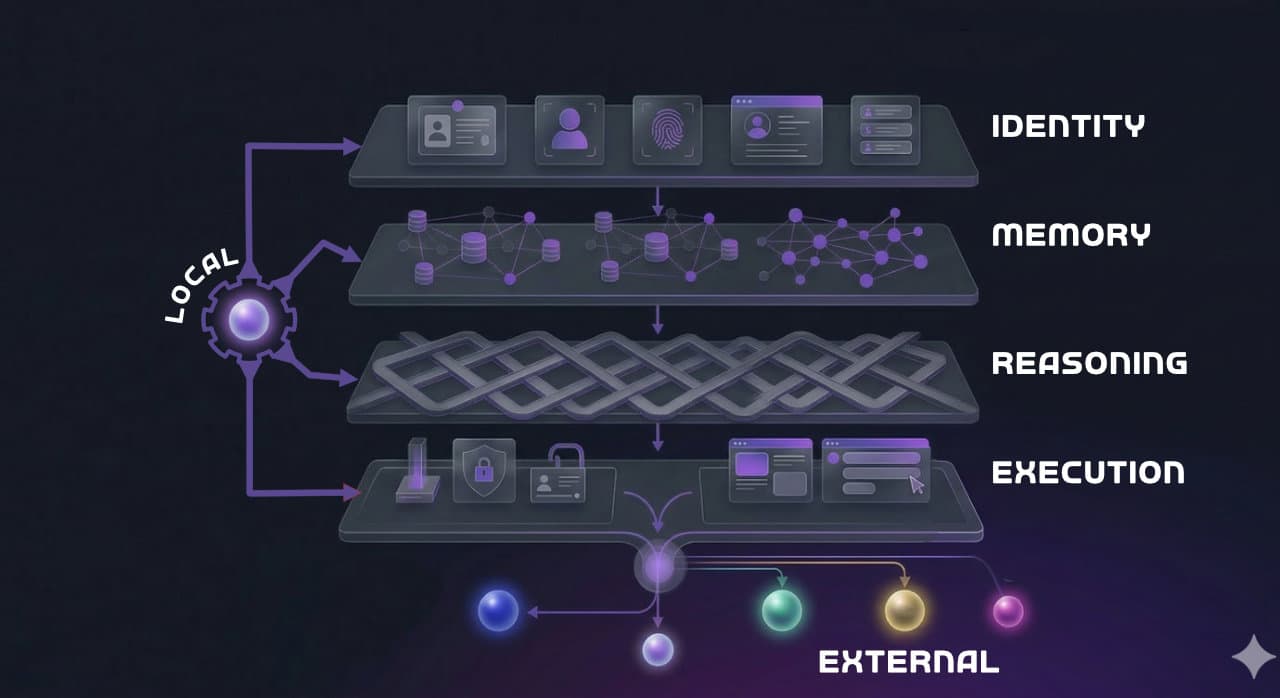
To make AI useful for real-world operations, several additional layers are needed.
- A way to define identity.
- A memory system that stores context and history.
- A reasoning layer that plans how tasks should be solved.
- An execution layer that interacts with tools and data.
- A model layer that contributes intelligence when needed.
Together these layers transform AI from a chat interface into a persistent intelligence system.
From Idea to Implementation
Once the concept became clear, the next step was building the platform that could support it.
The goal was not to create another chatbot.
The goal was to create an architecture capable of solving real problems while staying anchored to identity.
This platform includes several core capabilities.
- A runtime system that receives tasks and manages workflows.
- A reasoning engine that converts tasks into structured plans.
- A tool system that performs real work in the world.
- A model gateway that controls how AI models are used.
- A memory layer that records context and decisions.
These components form the foundation of an intelligence system that can reason, act, and learn over time.
Most importantly, they create a place where identity can live.
From Answers to Artifacts
The most important shift in this architecture is the output.
Traditional AI tools generate answers.
Identity-Centric systems generate artifacts.
An artifact might be:
- a structured plan
- a list of candidates
- a decision analysis
- a workflow
- a document ready for execution
Instead of returning a paragraph of advice, the system produces something the organization can actually use.
This difference turns AI from a conversational assistant into an operational partner.
The Beginning of Identity-Centric AI
The Christmas card mistake started as a joke.
But it exposed a deeper truth about modern AI systems.
They are powerful, but they are not anchored.
Without identity, AI systems naturally drift toward consensus.
The solution is not better prompts or larger models.
The solution is better architecture.
An architecture where identity sits at the center and intelligence works outward from it.
That architecture is what the Identity-Centric AI Platform is designed to provide.
The next step is seeing how this platform actually works in practice.
Because once identity, memory, reasoning, and execution are connected, AI stops producing generic answers and starts solving real problems.