
Last Christmas, AI betrayed me.
Not metaphorically.
Not philosophically.
Visually. Publicly. Permanently.
My brilliant and secretly ingenious wife surprised the family with custom Christmas cards. Using AI, she transformed our family photo into a Simpsons-style cartoon.
It was adorable.
It was clever.
It was mailed before I saw it.
Then the texts started.
“I didn’t know you switched.”
“Great card… except for you.”
I asked to see it.
There I was. Smiling. Festive. Animated. Wearing a Real Madrid jersey.
For Non-Soccer People: Let Me Translate
Imagine:
- A Michigan fan wearing Ohio State gear
- A Swifty in a Kanye West tee-shirt
- A lifelong Coke drinker featured in a Pepsi commercial
Now multiply by 100. That’s the level.
I have publicly and intentionally not supported Real Madrid since childhood.
That was a choice. A philosophy. An identity.
And AI erased it.
What Actually Happened
The original photo?
Me wearing a black Arsenal kit (2025 third kit).
The AI model likely:
- Detected “black soccer jersey.”
- Mapped to “globally dominant recognizable football brand.”
- Substituted Real Madrid because it’s statistically prominent.
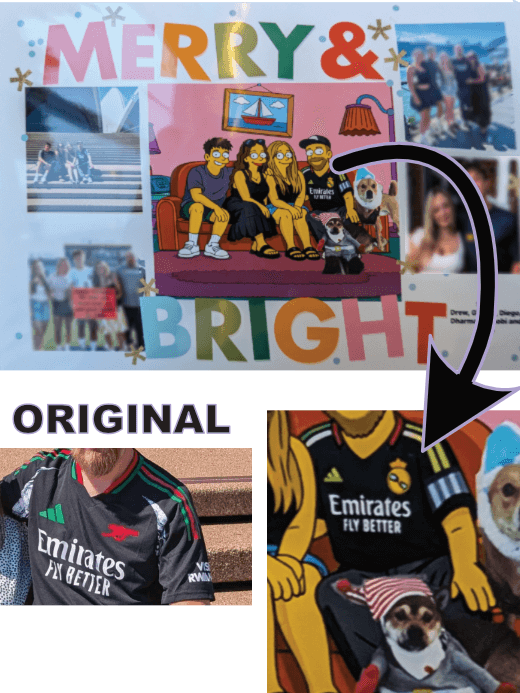
It optimized for familiarity.
Not truth. Not loyalty. Not identity.
Just probability.
The Real Problem (And Why This Isn’t Just a Joke)
Most people didn’t notice.
But everyone who knows me and soccer did.
And that’s the point.
AI flattens nuance.
It replaces:
- Specific with generic
- Identity with average
- Underdog with dominant
It doesn’t understand meaning.
It predicts likelihood.
And dominant brands are more likely in the training data.
Which means the underdog disappears.
Triage Mode
I went into crisis response.
Designed corrective stickers.
“Please affix over egregious error.”
Hand-delivered patches.
Yes. An analog hot-fix for a Christmas card.
My wife still insists:
“You can't really tell, they kind of look the same.”
The same!
It was an algorithm rewriting a part of who I am.
Here’s Why This Matters
We’re deploying AI into:
- Brand identity
- Strategic positioning
- Data interpretation
- Market narratives
- Executive decision support
If it can’t preserve a soccer allegiance, what makes us think it won’t:
- Default your niche product into a mainstream competitor?
- Smooth your differentiated strategy into something generic?
- Replace your edge with something “more common”?
Here’s the uncomfortable truth:
My allegiance, my history, my photos… that’s my data.
But Large Language and Image Models don’t use my data.
They use their training data.
When AI sees:
“Black soccer jersey with sponsor logo,”
it isn’t consulting my memories.
It’s calculating the most statistically likely match based on billions of examples.
These systems are consensus engines.
They generate what is:
- Most recognizable
- Most familiar
- Most agreed upon
Not what is most personally accurate.
And if you are differentiated by design, then you are statistically at risk of being averaged out.
The Marriage Part
We’re fine.
But if next year I show up in a Manchester United kit…
That’s counseling.
And that’s when it hit me:
This doesn’t happen again.
Not because I’ll stop using AI.
But because I’ll stop using it without a harness.
The Real Takeaway
The future isn’t just better models.
It’s better control layers.
So I started building something:
A personal identity harness.
A context and constraint layer that forces AI systems to reference my actual history before defaulting to global probability.
Because I don’t want consensus.
I want accuracy.
Next Christmas, I won’t be statistically reassigned.
There will be no Manchester United kit.
Tottenham isn’t even in the realm of possibility.
That’s the difference between using AI… And harnessing it.