It is easy to think of AI as a chatbot that answers questions.
You ask something. The model replies.
But that pattern breaks down when the task is operational.
Consider a real problem: securing a home field for a semi-pro soccer team.
The goal is not a paragraph of advice. The goal is a usable artifact: a shortlist of viable venues and the people to contact.
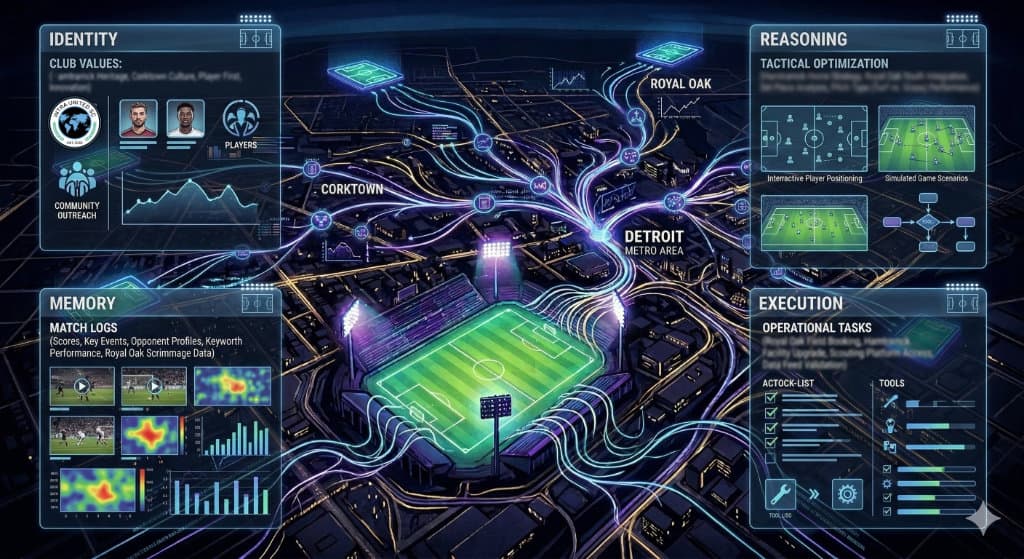
An Identity-Centric AI platform approaches the problem differently than a typical AI tool. Instead of asking a model for an answer, the system works through several architectural layers that anchor the task to the identity, constraints, and history of the organization it represents.
The Task
The request might look like this:
Secure a home field for the Intra United SC semi-pro team.
At first glance this sounds like a simple search task. But in practice the system must consider several factors:
- The team is based in Metro Detroit Area.
- The league requires turf fields.
- The Season id from April - August
- Matches occur on weekends.
- The output should include contact paths for outreach.
These requirements do not come from the model. They come from identity and memory.
Step 1: Identity
The system first establishes who it is working for.
In this case the entity is Intra United SC, a semi-professional soccer club operating in the Royal Oak area.
The identity layer provides core attributes that shape the task:
- The organization is a soccer club.
- Its geographic center is Metro Detroit Area.
- The output should support real match operations.
Without this identity layer, an AI system might suggest any field anywhere. With identity in place, the system understands that location, league suitability, and operational practicality matter.
Step 2: Memory
Next the platform retrieves relevant knowledge from memory.
For this task, memory might include known league requirements and operational constraints:
- The APSL requires matches to be played on turf.
- Games occur on Saturdays between 3pm and 9pm.
- Games occur on Sundays between 11am and 6pm.
- First home game after April 4th.
- Last home game before August 8th.
Memory transforms the request from a generic venue search into a constrained planning problem.
Now the system understands that acceptable fields must satisfy several criteria:
- Outdoor soccer facilities
- Turf playing surface
- Reasonable proximity to Metro Detroit
- Availability for weekend match windows
This context dramatically improves the quality of the result.
Step 3: Reasoning
The reasoning layer determines how the problem should be solved.
Rather than generating an immediate answer, the system creates a plan:
- Define the geographic search area around Metro Detroit Area.
- Identify candidate outdoor turf soccer fields.
- Filter facilities based on likely match suitability.
- Identify organizations responsible for the fields.
- Produce a structured list of candidates and contact paths.
This stage is not about creativity. It is about turning the request into a structured workflow.
The reasoning engine acts as the control plane that coordinates the rest of the system.
Step 4: Execution
Once the plan is defined, the platform executes the workflow.
This layer may involve several capabilities:
- Geographic lookup
- Facility discovery
- Filtering based on surface type
- Identification of facility operators
Execution combines deterministic operations with targeted use of models when necessary.
For example, a model might help classify whether a facility description indicates a turf field or extract the organization responsible for managing the venue.
Step 5: Model Participation
Large language models still play an important role.
But in an Identity-Centric system they are contributors rather than the authority.
The model might assist with:
- interpreting facility information
- structuring results
- generating summaries
All model requests pass through a gateway layer that controls how inference occurs. This gateway manages logging, routing, and policy enforcement.
The model provides intelligence, but the system controls the process.
Step 6: Artifact Creation
The final result is not a chat response.
It is a working artifact that the club can act on.
Conceptually, the artifact looks like this:
- Candidate Field A — Turf soccer complex near target area — Contact: district athletics office
- Candidate Field B — Municipal turf stadium — Contact: parks and recreation department
- Candidate Field C — High school turf facility — Contact: school athletic director
Each entry represents a potential venue along with a path for outreach.
This output can immediately support the next operational step: contacting facility managers and negotiating availability.
Step 7: Identity Validation
Before returning the artifact, the system evaluates whether it aligns with the club’s identity and constraints.
Questions include:
- Are the fields reasonably near Royal Oak?
- Do they meet the turf requirement?
- Do they plausibly support weekend match scheduling?
If a candidate fails these checks, the system can revise the results before presenting them.
The Full Flow
The complete workflow looks like this:
- User request
- Identity layer loads context for the club
- Memory retrieves league rules and operational knowledge
- Reasoning creates a structured plan
- Execution performs discovery and filtering
- Models assist with classification and synthesis
- The system assembles a candidate venue artifact
- Identity validation ensures the result fits the organization
The important point is that the model is only one component.
The system around the model ensures that the output remains consistent with the entity it serves.
Why This Matters
Traditional AI tools generate answers.
Identity-Centric AI systems generate artifacts that organizations can use.
By grounding intelligence in identity, memory, and structured reasoning, the platform produces results that are tailored to the specific needs of the entity it represents.
In this example, the system is not simply suggesting fields.
It is helping a club solve a real operational problem.
That difference is what turns AI from a chatbot into a working intelligence system.